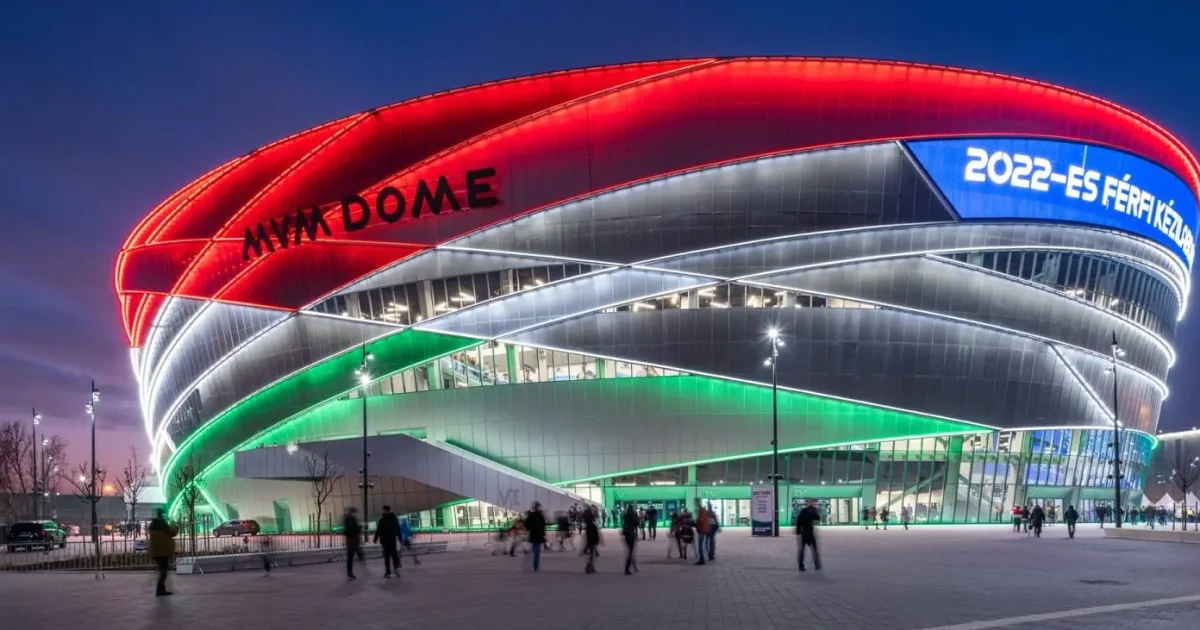
The MVM Dome is one of the newest, most ambitious – and perhaps most shared – elements of Budapest’s cultural fabric. Billed in the official narrative as one of Europe’s most modern multifunctional arenas, the complex boasts truly impressive dimensions and technical capabilities. However, the question that a truly curious and critical mind cannot avoid is: is this colossal space really capable of conveying a more intimate, human experience during a concert, or will it ultimately remain a gigantic event-moving machine that lacks soul?
As a first impression, the MVM Dome impresses. Its size, its curve, its shape, the way it stands almost alone on the outskirts of the suburbs – it is truly monumental. The internal proportions of the space are also impressive: huge ceilings, almost infinite viewing space, austere but sterile functionality. Everywhere you look, you can feel the aim: not to launch small club bands, but to export global names to the Budapest stage.
For example, the sound technology is excellent when it comes to a production that suits the arena. A world touring orchestra, with its own sound engineering team and pre-customised spatial soundstage, can take advantage of the Dome’s capabilities. The sound is spacious and clear, and the experience is technically satisfying. But at a concert by a lesser-known artist, or an event with a smaller budget, the situation is different: the space absorbs the sound, the dynamics dissipate, and the viewer becomes an unwittingly distant spectator to what seems more like a rehearsal than a real performance.
The lack of intimacy is a particularly sore point. A concert, if it is to evoke a real, internal vibration, is not just sound and light – it is also presence. In the case of the MVM Dome, however, this presence is often lost. The crowd of spectators becomes a homogeneous mass, the artist on stage – even if magnified on the screens – is often only a visual context, not a direct experience.
And we haven’t even mentioned the strange duality that the location of the arena suggests. Slightly separated from the hustle and bustle of the city centre, it is located on the border between the suburbs and the industrial zones, which has certain logistical advantages (e.g. parking, proximity to busy roads), but in cultural terms it is precisely this isolation that makes it less integral to the musical life of Budapest. It’s no coincidence that while an Aquarium or an A38 is woven into the fabric of the night with the organic pulse of live music, the MVM Dome’s events are often more like theatrical performances, where the audience spills out, disappears – and the city is not part of the experience.
This is particularly striking when there is only one goal for the evening: to ‘finish’ the concert. No spontaneous beer beforehand, no chance meeting afterwards, no other venue to drift off to. When you leave the MVM Dome, you don’t come back to the pulsating musical world of Budapest – you come back to the logistical challenge of a well-organised post-event.
And that’s where it comes in: the MVM Dome is professional but sterile. Impressive, but hard to like. A great place for a world star to play his usual show as part of a continental tour – but a bad place to create something truly unrepeatable. And that, strange as it may sound, is a serious shortcoming.
Because a concert – the real thing – is not just a stage and sound equipment. It is an event. Something that not only happens, but happens – to us. In the Dome, that experience is easily lost. There’s still the spectacle, the order, the scalability – but the warmth that emanates from the most memorable evenings is often trapped outside the walls.
So if you’re looking for an authentic concert experience, soaked in blood and sweat, the MVM Dome may not be the place you want to return to again and again. An imposing stage for cosmopolitan ambitions – but perhaps too big to be inhabited by a true soul.